The project outlined an initiative titled “Dissemination and adoption of climate-smart farming systems: A case of elite Pasture Production, Agro-forestry and Water Management Schemes in Uganda”. Executed by AGRENES and AGRILIV in partnership with NARO-NaLIRRI, FAO, CURAD, and local government actors under an EU-funded framework, the MOBIP-RAWM project focused on boosting the beef sub-sector across nine districts in Uganda’s cattle corridor. The project was split across two Disease Control Zones (DCZ 1 and DCZ 2) covering Nakaseke, Nakasongola, Masindi, Kyankwanzi, Kiboga, Mbarara, Isingiro, Kiruhura, and Sembabule districts.

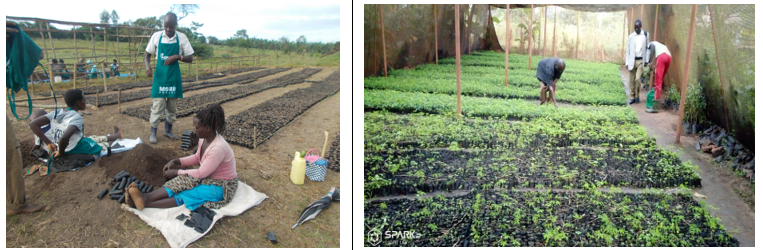
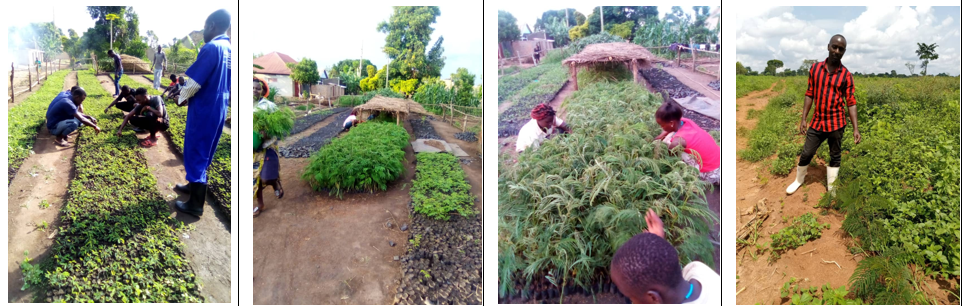
Farmers and local actors work together in agroforestry nurseries to raise multipurpose tree seedlings and elite forage species. Supported by AGRENES and NARO-NaLIRRI, these initiatives empower women, youth, and livestock farmers to restore degraded rangelands and improve feed availability across Uganda's cattle corridor.
Back ground
The project was necessary due to critical structural, environmental, and socio-economic challenges that affected Uganda’s rangelands:
Severe Climate and Environmental Degradation: The cattle corridor was characterized by semi-arid to dry conditions, erratic rainfall, high temperatures, and frequent, prolonged droughts that caused pasture shortages and water scarcity.
Rangeland and Pasture Decline: Overgrazing and low-quality traditional forages led to declining livestock productivity.
Water Insecurity: Access to safe water in rural rangeland areas was below 60% in 2016, with reduced functionality of existing water points.
Deforestation and Encroachment: Dependence on wood biomass for energy led to bush clearing, charcoal burning, and massive loss of forest cover.
Sub-Optimal Livestock Production: Due to poor genetic potential of local cattle, rudimentary management practices, and lack of feed conservation, beef production remained at 200,000 metric tons, far below its 360,000 metric ton potential.
Inadequate Farmer Coping Strategies: Farmers previously relied on distress livestock sales, migration, and overstocking, none of which offered long-term solutions.
Gender Disparities: Women faced significant barriers regarding access to, ownership of, and control over production resources.

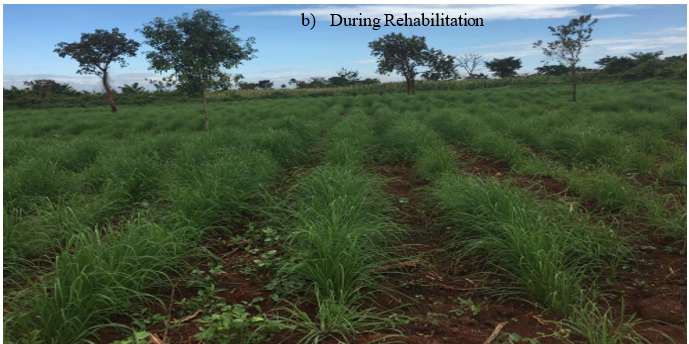
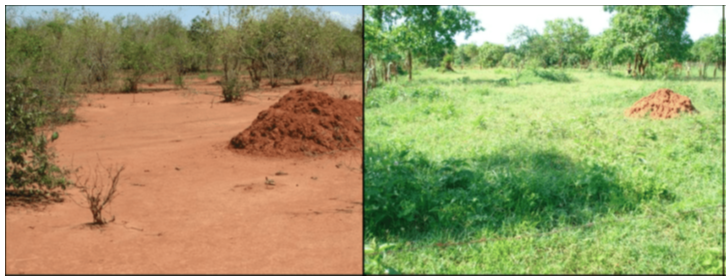
Arid and degraded rangeland environment marked by severe moisture stress, sparse vegetative cover, and bare eroded soils prior to climate-smart pasture establishment and ecosystem restoration.
Project objectives.
- Promote gender-responsive and inclusive climate-smart forage production technologies, innovations and management practices.
- Develop the capacity of beef producers and district actors in sustainable and integrated water resources management.
- Promote agroforestry and rehabilitation of degraded rangeland habitats and watershed areas.
- Develop the capacity of stakeholders in sustainable exploitation of synergies in crop-livestock integration.
- Develop Mechanisms for Monitoring and Weather-Related Risk Management
Justification of the interventions.
In Uganda, beef cattle production systems are the most predominant in the corridor, where they are majorly rain-fed, with pastoral and agro-pastoral systems accounting for more than 90% of the total cattle numbers (FAO, 2017). About 44% of the total land area in Uganda is covered by rangelands (Byakagaba et al., 2018; NEMA, 2015); and supports more than 90% of the ruminant population (UBOS and MAAIF, 2010). The semi-arid environments of these rangelands are often characteristic of erratic rainfall regimes, high temperatures, frequent and long droughts. Therefore, climate change remains the single major threat to the realization of increased livestock production because of its impact on the quantity and quality of feed crops and forages, water availability, proliferation of livestock diseases, animal reproduction, and biodiversity (Kiggundu et al., 2018; Rojas-Downing et al., 2017).
Climate change, coupled with overgrazing, have culminated in inadequate and poor-quality pastures and declining water resources in the rangelands dwindling their potential to support the current and projected demands for beef products. In fact, access to safe water resources in the rural rangeland areas was estimated at less than 60% in 2016, and this needs to be greatly improved for enhanced livestock productivity. The trends in the establishment of safe water points inform of boreholes, valley dams and natural springs as whereas their functionality for the rural poor has reduced to 85%, thus threatening livestock productivity.
Most rural households, especially those headed by women, are heavily dependent on wood biomass as a cheaper and affordable alternative to electricity and gas. This has resulted in massive encroachment and unsustainable exploitation of tree and rangeland resources through bush and charcoal burning activities. Therefore, sustainable management of forest cover and rangeland resources has the potential of reducing negative impacts of climate change, especially greenhouse gas (GHG) emissions. In addition, there is a widening gender gap in Uganda’s agricultural sector, including the beef sub-sector that often favours men rather than women in the ownership, access to and control of production resources.
To address the aforementioned challenges, AGRENES under the EU-funded MOBIP-RAWM project facilitated dissemination and promoted the adoption of novel agricultural technologies and climate-smart farming systems, which enhanced beef productivity and restoration of the degraded rangeland ecosystem in Uganda. In this case, the key result areas were; sustainable agroforestry, pasture production schemes and integrated water management systems.

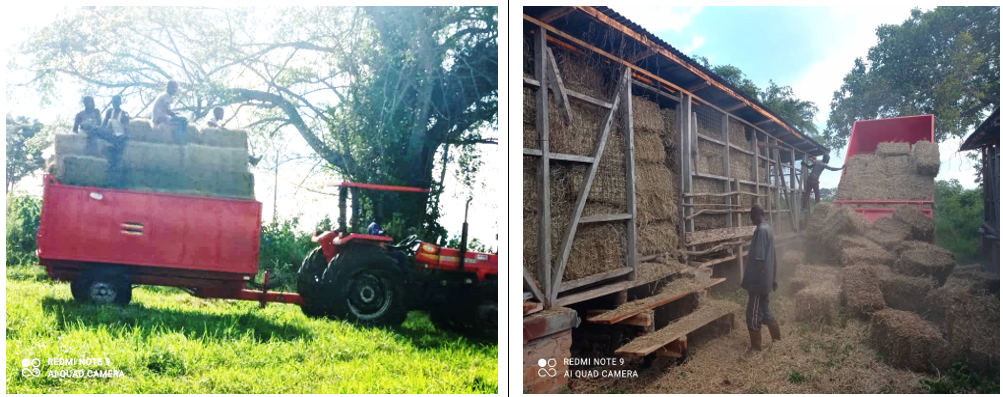
Farmers harvesting fodder and storing baled hay under the MOBIP-RAWM project to tackle feed scarcity and build livestock resilience during dry seasons in Uganda's cattle corridor
IMPACTS
1.Establishment of new gardens with improved and drought-tolerant pastures

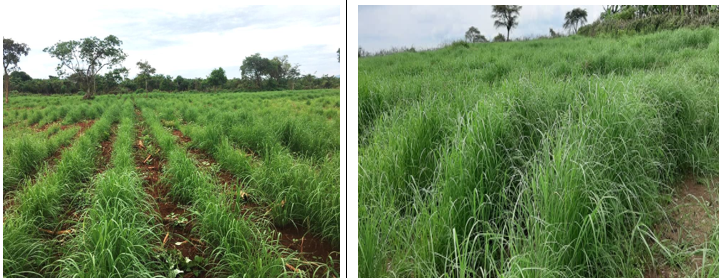
A total of 483 acres of new pasture gardens were established on 37 private beef farms across the cattle corridor in the nine target districts under the MOBIP-RAWM project. On average, 13 acres of Chloris gayana and Centrosema pubescens gardens were established on each beef farm. The process of creating seedbeds for the new seed pasture gardens involved five steps, namely site selection, bush clearing to remove shrubs, levelling of the seedbed, manual and mechanical ploughing, and harrowing of the seedbeds. The established pasture gardens were maintained by re-seeding and seasonal weeding cycles. Figure 2 shows sample field photos taken during sowing of Chloris gayana pastures at a beneficiary beef farm in Nakasongola district.
- Restoration of the degraded pasture land ecosystems
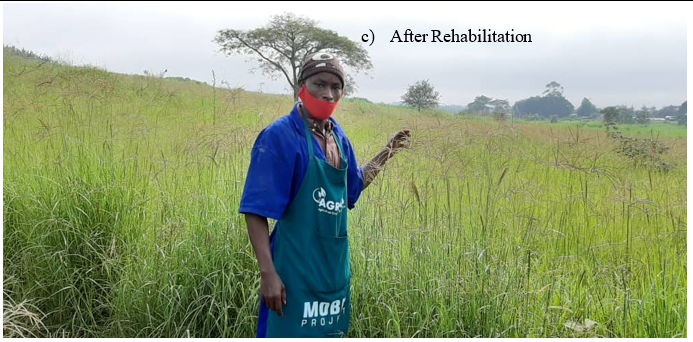
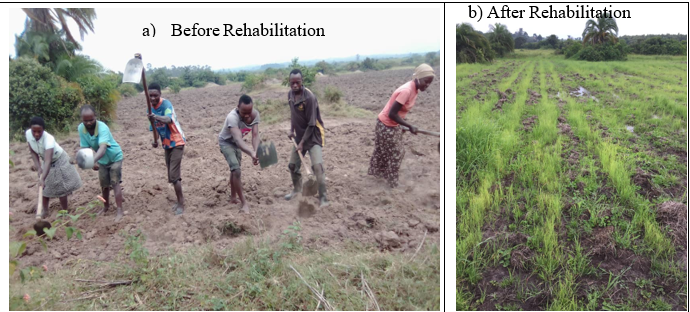
A total of 405 acres of the degraded pasture and rangeland ecosystems were established on 46 private beef farms across the nine districts under the MOBIP-RAWM project. On average, 9 acres of degraded pasture and rangeland ecosystems were restored and propagated with elite Chloris gayana and Centrosema pubescens species. The pasture rehabilitation process involved site selection and delineation of the degraded pasture lands followed by bush clearing to remove the shrubs, thickets and tree stamps. Afterwards, tractors and other farm equipment (e.g. hoes) were deployed to plough the cleared land and level the seedbed ecosystem, respectively. Seeds of Chloris gayana and Centrosema pubescens species were sowed and intercropped with the traditional pasture legumes. The rehabilitated pasture land ecosystem was maintained by re-seeding and seasonal weeding cycles.


Restoration of the degraded rangeland ecosystems.

Most of the degraded rangeland ecosystems were infested with diverse species of obnoxious weeds, termites and invasive scrubs. As part of the restoration efforts, preliminary activities included bush clearing to remove aggressive invasive shrubs, termite control and weed to spot removal of enormous unpalatable herbaceous weeds in selected rangeland ecosystems. Figure 7 shows photos taken during the restoration of the degraded rangeland ecosystems.
2: Promoting agroforestry in the degraded rangeland ecosystems


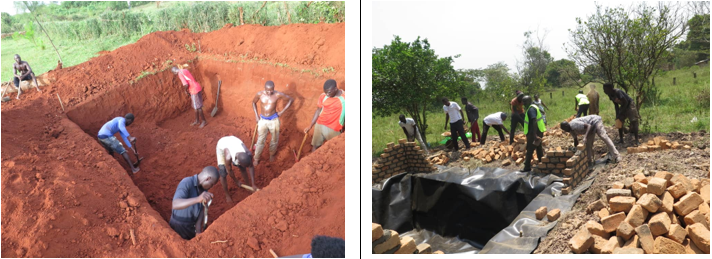
3: Developing capacity of the beef producers and district actors in sustainable and integrated water resources management.


4: Developing capacity of the beef producers and district actors in sustainable and integrated water resource management.
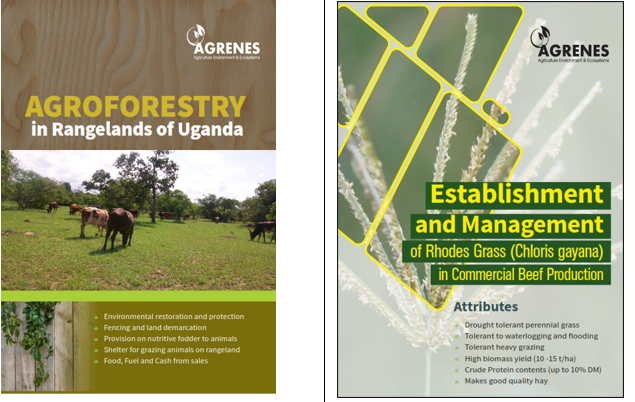
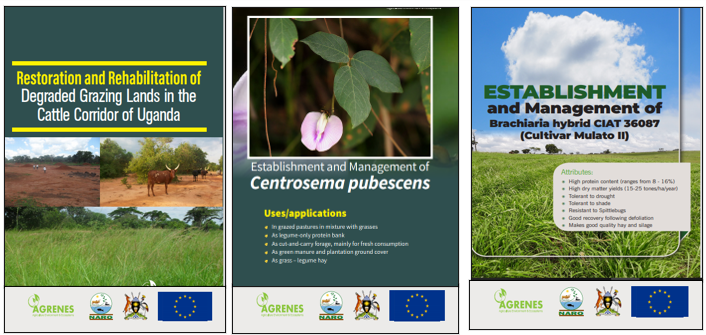
Five different types of training materials for agroforestry forage
and pasture production were designed
and produced. The materials were used in training farmers and also disseminated
to different beef farming communities across the nine districts under the
MOBIP-RAWM project. Figures 8 presents cover page photos for the new forage
guides and pasture albums designed and produced by AGRENES under the MOBIP-RAWM
project.


ACHIEVEMENTS: PROJECT RESULTS, OUTCOMES AND IMPACT

The MOBIP-RAWM project restored 405 acres of degraded rangeland ecosystems and established 483 acres of new pasture fields across nine districts, with private farm adoption split between men (70%) and women (30%).
1. Increased productivity of forage seed and feed resources


The economic impact of improved pastures under the project was evaluated using the Return on Investment (ROI) and Benefit-Cost Ratio (BCR) approach (Boardman et al., 2017) at an exchange rate of 1 USD to 3,520 UShs. For Chloris gayana, seed production costs UShs 25,000 per kg and sells at UShs 45,000 per kg, yielding a net profit of UShs 20,000 per kg; this generates UShs 5,829,200,000 in seasonal net revenue across 291,460 kg of seeds (BCR of 2.11), while processing its 21,405,200 kg of seasonal dry matter into hay at UShs 300 per kg brings UShs 6,421,560,000 in seasonal revenue (BCR of 2.12). Meanwhile, Centrosema pubescens provides fresh forage for zero-grazing systems and hay at a production cost of UShs 35,000 per kg and a market price of UShs 60,000 per kg, yielding a net profit of UShs 25,000 per kg and generating UShs 40,074,900,000 in annual net revenue for beneficiary beef farmers across 1,602,996 kg of annual dry matter.
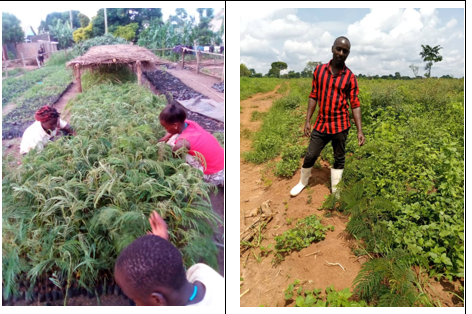
Integrating agroforestry with elite forage species provides critical dry-season feed for beef cattle, with tree fodder biomass estimated using a dendrometric model based on trunk girth, total height, stem height, and crown diameter (Sèwadé et al., 2017). Each multipurpose tree produces an average of 14.5 kg of dry matter (DM) annually (ranging between 10 and 19 kg DM per tree), yielding a mean carrying capacity of 0.012 to 0.016 Tropical Livestock Units (TLU; standard 250 kg live weight) per acre per year (Sèwadé et al., 2017). Applying these parameters to the 400,000 multipurpose agroforestry tree seedlings established under the project results in 5,800,000 kg of annual DM production, sustaining a carrying capacity of 252 to 336 beef cattle per year and substantially expanding the last-mile availability of high-protein leaf forage during prolonged dry spells.
4. Contribution of the new water infrastructures on beef production

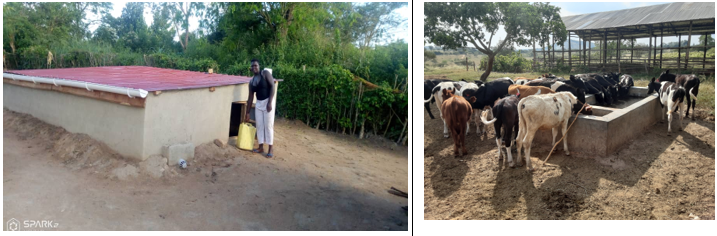
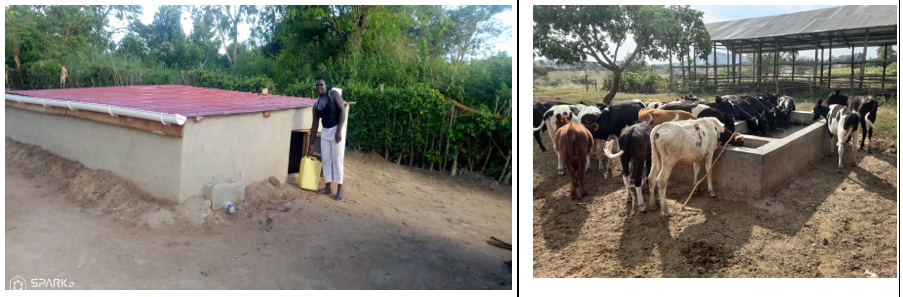
Under the MOBIP-RAWM project, 18 new water infrastructures were constructed—complete with rooftop rainwater harvesting facilities—to address critical water scarcity across the nine cattle corridor districts, particularly during prolonged droughts. Each 30,000-liter facility supplies clean water for livestock and domestic use, yielding a combined total of 540,000 liters of quality water resources capable of supporting over 98,182 head of cattle during dry months while saving vulnerable feeding calves from walking long distances to water points. Beneficiaries like Mr. Rwakanuma Ephraim of Katuugo Sub-county, Nakasongola District—who previously spent 3–4 hours daily fetching water by bicycle from a well 7 km away—now reliably access on-farm water to sustain their household needs and livestock (such as his 150 goats and 10 beef cattle), a transformational impact mirrored across beneficiary farms throughout the target districts.
CHALLENGES FACED DURING PROJECT IMPLEMENTATION
COVID-19 Restrictions: Travel bans and prohibitions on community gatherings delayed field activities, preventing group capacity-building and training sessions.
Pasture Germination & Extreme Weather: Despite using high-quality forage seeds, adverse weather conditions—including dry spells, erratic rainfall, flooding, and severe soil erosion—lowered seed germination rates. In Nakaseke and Nakasongola, post-sowing torrential rains and erosion reduced germination from 99% to 70%, requiring extra expenditure on seed re-purchases, re-seeding, and labor.
Agroforestry Nursery Pressures: To prevent fast-growing tree seedlings from outgrowing their nurseries during gathering bans, AGRENES pivoted from group training to individual farm-level training and planting. This shift increased operational costs for seedling transportation, team facilitation, and additional shade nets.
Emerging Opportunities from Project Interventions;
Improved Forage Options:
Chloris gayana: Highly valued as a drought-, flood-, and heavy-grazing-tolerant perennial grass with high biomass yield (10–15 t/ha), high crude protein content (up to 10% DM), and superior hay quality.
Centrosema pubescens: Versatile legume used in grass-legume mixtures, as a standalone protein bank, cut-and-carry fresh forage, grass-legume hay, green manure, and plantation ground cover.
Agroforestry Multi-Services: Nursery-raised tree seedlings provide fodder, fix nitrogen, protect against soil erosion, and restore degraded catchments and watersheds.
Integrated Water Management: The 30,000-liter household-level water facilities supply water for calves near homesteads, irrigate tree nurseries, and meet domestic needs—saving labor previously spent fetching water from long distances. On-farm access also prevents cattle from crowding at communal water points, reducing land trampling and ecosystem degradation.